Machining Titanium: Grades, Challenges & Best Practices
A practical guide to machining titanium - Grade 2 vs Ti-6Al-4V (Grade 5), why titanium is difficult to cut, and the speeds, tooling and coolant strategies that make it work.

Titanium occupies a special place in precision manufacturing. It is nearly as strong as steel at little more than half the weight, it resists corrosion in environments that would destroy most metals, and it is biocompatible enough to live inside the human body for decades. Those properties make it the default choice for jet engines, airframes, surgical implants, and high-performance hardware. They also make it one of the most demanding materials a machine shop will ever cut.
This guide explains the titanium grades you are most likely to specify, why the metal is so difficult to machine, and the proven strategies — speeds, tooling, rigidity, and coolant — that turn a troublesome material into accurate, repeatable parts.
Why Engineers Choose Titanium
Three characteristics drive almost every titanium decision. First, its strength-to-weight ratio is exceptional: alloyed titanium rivals many steels in strength while weighing about 40% less, which is why aerospace structures lean on it heavily. Second, its corrosion resistance is outstanding — a thin, self-healing oxide layer protects it against seawater, chlorides, and many acids. Third, it is biocompatible, so the body tolerates titanium implants without rejection, making it central to medical and dental devices.
The price of those benefits is cost — both raw material and machining time — so titanium is reserved for applications where its performance genuinely earns its place, rather than as a general-purpose metal. Where weight and corrosion are less critical, alternatives such as aluminium alloys or stainless steels are usually more economical, a trade-off we compare directly in our guide to choosing between aluminium, stainless, and titanium.
The Grades You Are Most Likely to Specify
Titanium is supplied as commercially pure (CP) grades and as alloys. Two dominate industrial work: Grade 2, a commercially pure titanium prized for corrosion resistance and formability, and Grade 5 (Ti-6Al-4V), the workhorse alloy that accounts for the majority of all titanium used. Grade 23 is a higher-purity version of Grade 5 used for medical implants.
| Grade | Type | Key Strength | Typical Uses |
|---|---|---|---|
| Grade 1 | CP titanium | Most formable, best corrosion resistance | Chemical processing, marine, foil |
| Grade 2 | CP titanium | Balanced strength and corrosion resistance | Heat exchangers, valves, marine hardware |
| Grade 5 (Ti-6Al-4V) | Alpha-beta alloy | High strength, heat-treatable | Aerospace structure, engine parts, fasteners |
| Grade 23 (Ti-6Al-4V ELI) | Alpha-beta alloy | High strength with extra-low interstitials, fracture-tough | Surgical implants, medical devices |
| Grade 7 | CP + palladium | Best resistance to reducing acids | Aggressive chemical environments |
Why Titanium Is Hard to Machine
Titanium's machining difficulty comes from a combination of physical properties that each work against the cutting tool.
- Low thermal conductivity. Titanium does not carry heat away from the cutting zone the way aluminium does. Instead, heat concentrates at the tool edge, where temperatures spike and accelerate tool wear. Roughly speaking, far more of the cutting heat stays in the tool and workpiece than with steel.
- Work hardening and chemical reactivity. Titanium hardens locally when worked and reacts chemically with cutting tools at high temperature, encouraging galling, built-up edge, and rapid flank wear. A tool that dwells or rubs instead of cutting cleanly will fail quickly.
- Low elastic modulus. Titanium is about half as stiff as steel, so it springs away from the tool and then back, causing chatter, deflection of thin features, and rubbing on the tool flank. Rigid work-holding is essential.
- Chip behaviour and fire risk. Titanium produces thin, tough chips that can ignite if they overheat. Fine titanium chips and dust are flammable, so chip management and coolant are safety matters, not just quality ones.
Best Practices for Machining Titanium
None of these challenges are insurmountable. Shops that machine titanium routinely follow a consistent recipe built around keeping the tool cutting cleanly and the heat under control.
Run Lower Speeds, Maintain Feed
Cutting speed (surface feet per minute) is the biggest lever on tool temperature, so titanium is cut far slower than aluminium or mild steel. At the same time, the tool should keep a steady, healthy feed per tooth — never dwell or rub — because a constant chip load keeps heat in the chip and off the tool. The combination of moderate-to-low speed and consistent feed is the foundation of titanium machining.
Keep Everything Rigid
Because titanium deflects and chatters, rigidity is non-negotiable: short, stout tools held with minimal overhang, solid fixturing that supports thin walls, and machines with little backlash. Climb milling is generally preferred, as it starts the cut at maximum chip thickness and exits thin, reducing rubbing and work hardening.
Flood the Cut With Coolant
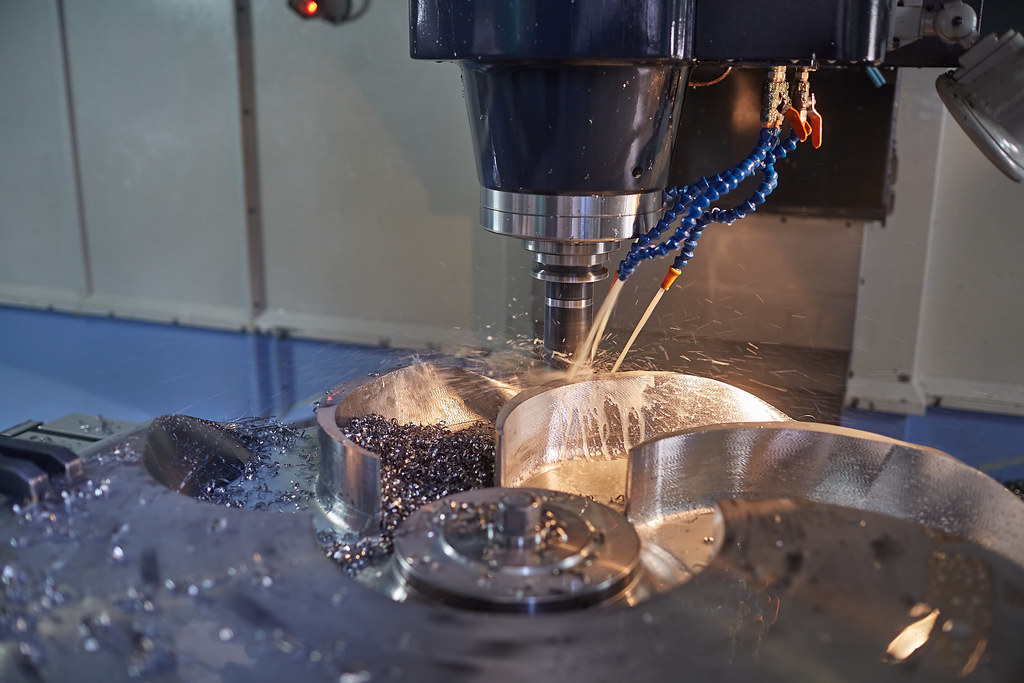
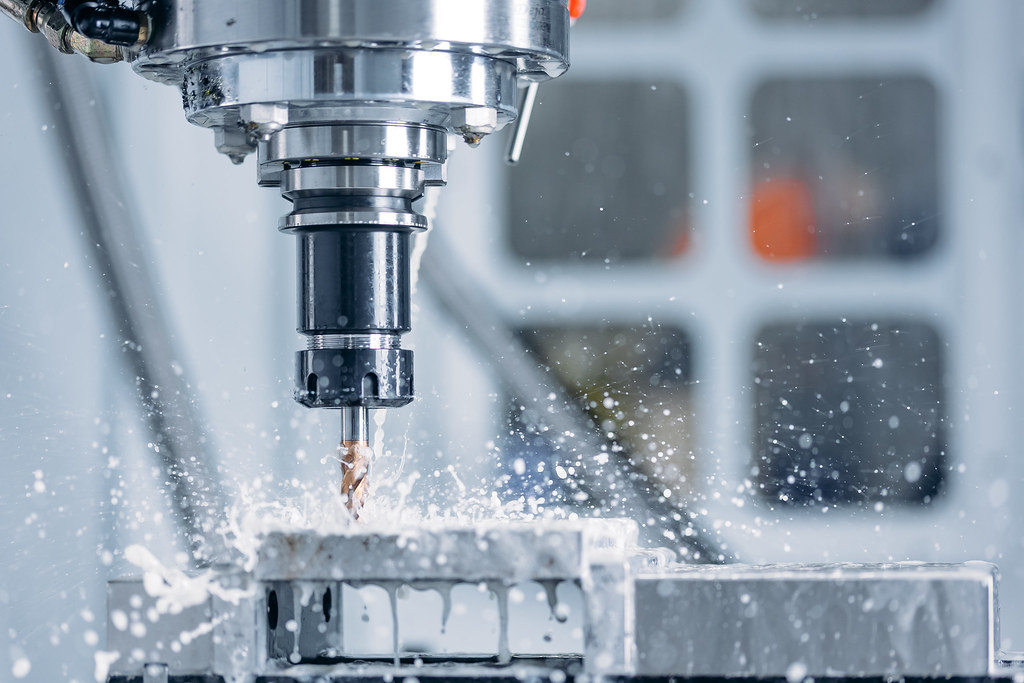
High-pressure, high-volume coolant aimed directly at the cutting edge does double duty — it carries heat away and flushes chips clear before they can re-cut or ignite. Many titanium operations rely on through-tool coolant for exactly this reason. Adequate coolant is also the primary defence against the chip-fire risk.
Use Sharp, Wear-Resistant Tooling
Titanium rewards sharp, positive-rake carbide tooling and punishes dull edges. Tools should be indexed or changed on a predictable schedule rather than run to failure, because a worn edge generates more heat and can fail catastrophically. Coated carbides chosen for titanium, and generous use of fresh edges, keep the cut clean.
Inspection and Finishing Considerations
Titanium parts often carry tight tolerances and demanding traceability, especially in aerospace and medical work. Plan for thorough dimensional verification — frequently on a coordinate measuring machine — and for full material certification. Surface finishing such as passivation, anodizing (which produces titanium's characteristic colours without dye), or media blasting is common; specify it deliberately, as each step adds cost and lead time.
Where Titanium Earns Its Keep
Despite the machining challenge, titanium is irreplaceable in the right application. In aerospace, its strength-to-weight ratio reduces fuel burn and survives engine temperatures. In medical devices, its biocompatibility and fatigue strength make it the standard for implants and instruments. In chemical and marine equipment, its corrosion resistance outlasts steel by years. Heat treatment of the alpha-beta alloys can further tune strength, a topic we cover in our guide to heat treatment of metals.
Machining titanium well is as much about discipline as it is about settings — rigid setups, sharp tools, controlled speeds, and relentless coolant. MechPart Pro machines titanium routinely for aerospace, medical, and industrial customers, with the fixturing, tooling, and inspection systems these alloys demand. If you have a titanium part in development, upload your model and drawing for a quote and free manufacturability feedback, and we will advise on grade selection, tolerancing, and finishing to keep cost and risk in check.
Related capabilities
Have a part to make?
Upload your CAD for a detailed quote and free DFM feedback within 24 hours.